

 Login
 Post an ad


How to fund a motorsport season as an amateur driver
By RobinB on 24 November 2026 Miscellaneous
A motorsport season is expensive, even in the "small" categories. Entry fees, tyres, fuel, travel, maintenance, crash damage… The bill climbs fast, and talking about money is still a bit taboo in the paddock 🤔 On GoToTheGrid, we prefer to put our cards on the table: we regularly break down the budgets of many categories, from karting to rallying and circuit racing.
So how do all these amateur drivers manage to race every year? Personal money, partners, a non-profit association, prize money… Let's look at how a season really gets funded when you're neither a factory driver nor the child of a millionaire.
ℹ️ Prefer to watch a video? This article is also available as a video on YouTube, click here! 🎥
💬 A quick word first. This article covers the questions I get asked most often in private messages. I'm not a professional driver: karting, rallying in an AX F2000, circuit racing in a Ligier JS2 R and a Clio Cup, endurance in TTE and the Fun Cup… I race as an amateur, with my own budget and my partners. What follows is my advice and my opinion, nothing more. Every situation is different! The tax and legal sections describe the French system.
Who pays for amateur drivers' seasons?
The answer fits in one sentence: personal money, partners, or a mix of both. Drivers backed by a manufacturer or a factory team remain a tiny minority.
In the most affordable categories, you can sometimes fund your season from your salary, especially if you do a lot of the work yourself or with friends. But as soon as you want to race a bit more, you quickly need partners.
It's no coincidence that paddocks are full of tradespeople, freelancers, self-employed professionals and business owners. They often have a bit more financial headroom, but above all a professional network. And in amateur sponsorship, the network makes the difference.
For some, the family covers a large part of the season, or all of it. That obviously changes everything. Everyone works with their own situation, but without that help, you need to be creative.
How to find sponsors in motorsport?
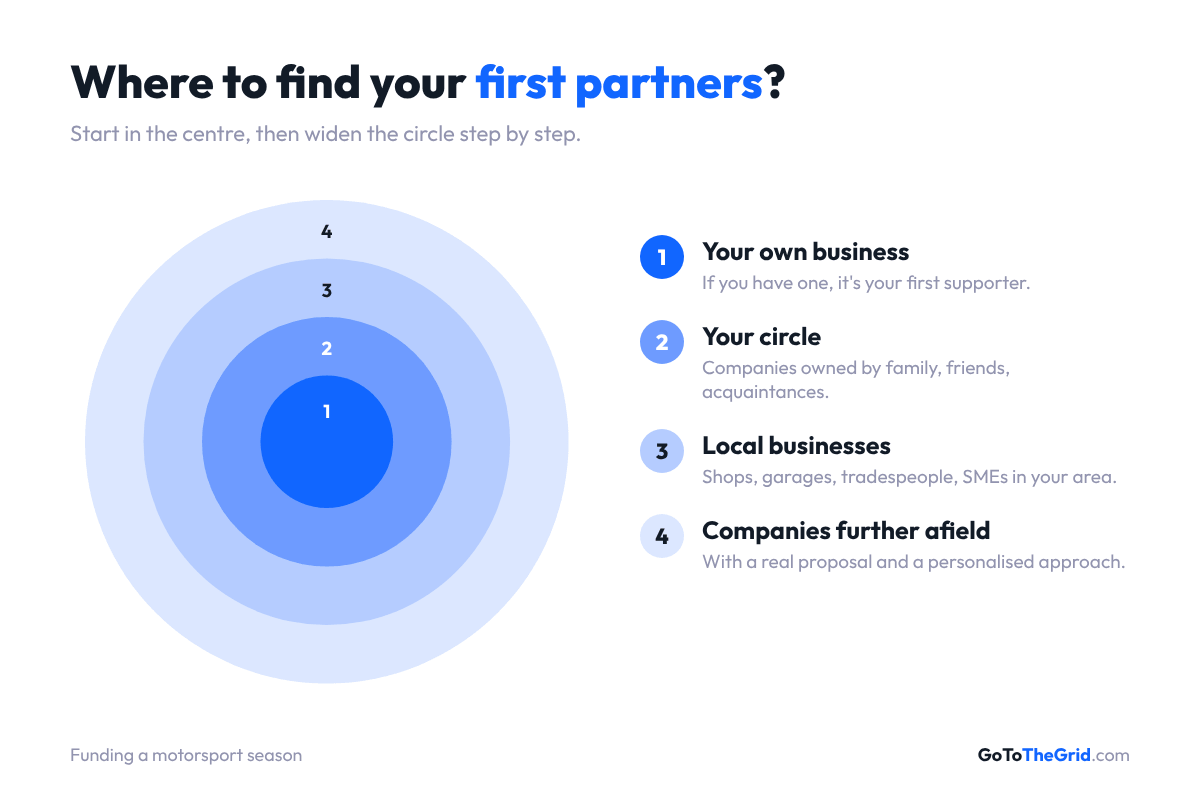
There's no magic formula, but there is a logic of widening circles:
- Your own business, if you have one.
- Your circle: companies owned by family, friends and acquaintances.
- Local businesses: shops, garages, tradespeople and SMEs in your town or region.
- Companies further afield, with a real proposal and a personalised approach.
At first, it's often a few hundred euros here and there, the loan of a trailer, a free service, parts at cost… Added together, that can be enough to get started.
Some drivers also raise funds through social media. Several young drivers have built a community on TikTok or Instagram, then turned that visibility into partnerships and finally got racing. It takes a huge amount of work, but it works.
Which companies should you approach?
A company with a link to your project will be much easier to convince. A garage, a body shop, a parts or tyre dealer is already talking to car enthusiasts. A shop or small business in your town will mainly care about local visibility, especially if you race close to home. Before sending anything, ask yourself a simple question: who are this company's customers, and what can your season bring them?
The discipline matters too. A road-registered slalom car that's driven every day shows the logos all year round, not just on race days: a real argument when talking to a local business.
What to put in your sponsorship proposal?
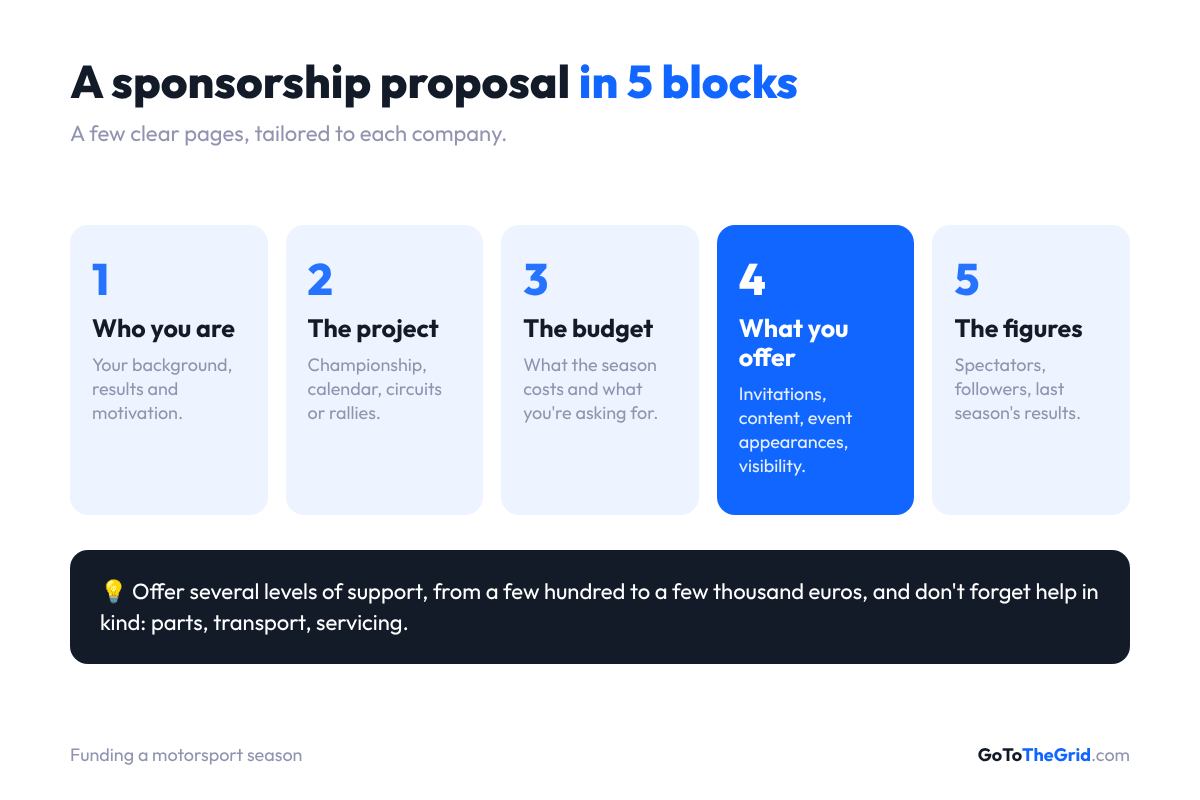
No need for a huge document: a few clear pages are enough, tailored to each company. It usually covers who you are and your background, the season's project (championship, calendar, circuits), the budget and what you're asking for, and above all what you offer in return, with concrete figures: spectators, social media followers, results from the previous season. Good photos and a mock-up of the car wearing the partner's logo often make more impact than a long text.
Offer several levels of support, from a few hundred to a few thousand euros, without forgetting help in kind (parts, transport, servicing). A company will find it easier to say yes to a small amount to start with, then increase it the following year if all goes well. The proposal is only a support: nothing beats a meeting or a face-to-face conversation.
And if you're looking for partners, a seat or teammates, check out the sponsorship listings on GoToTheGrid 😉
Why would a company fund an amateur driver?
Let's be honest: at amateur level, a logo on a door rarely boosts a company's sales. Yet motorsport sponsorship can serve many other purposes. First, local marketing, especially for a business in the area. Then customer relations, by inviting clients or prospects to a race or a test day. It also provides content for the company's social media, website or newsletter, and feeds its business network: one business owner backing another often sees a return eventually, one way or another. And sometimes it's quite simply passion: the boss loves motorsport and wants to help a driver they know.
That last point is often underestimated. Much of amateur sponsorship is built on personal relationships: someone knows someone, likes the project, and decides to join the adventure.
What you can offer in return
That's why we prefer to talk about partners rather than sponsors: both sides need to get something out of it. The real question is what you can bring the company in exchange for its money. A few concrete ideas:
- paddock invitations for the partner, its staff or its clients, with a garage visit and explanations;
- a passenger ride or track day for a client or a competition winner;
- the car on display at a trade show, an opening or outside a shop;
- photos and videos the company can use in its own communication;
- regular posts on your social media, with reach figures to present at the end of the season;
- and of course visibility on the car, race suit and helmet.
Stickers alone are almost never enough. What makes the difference is a proposal designed for the company in front of you, and real follow-up throughout the season.
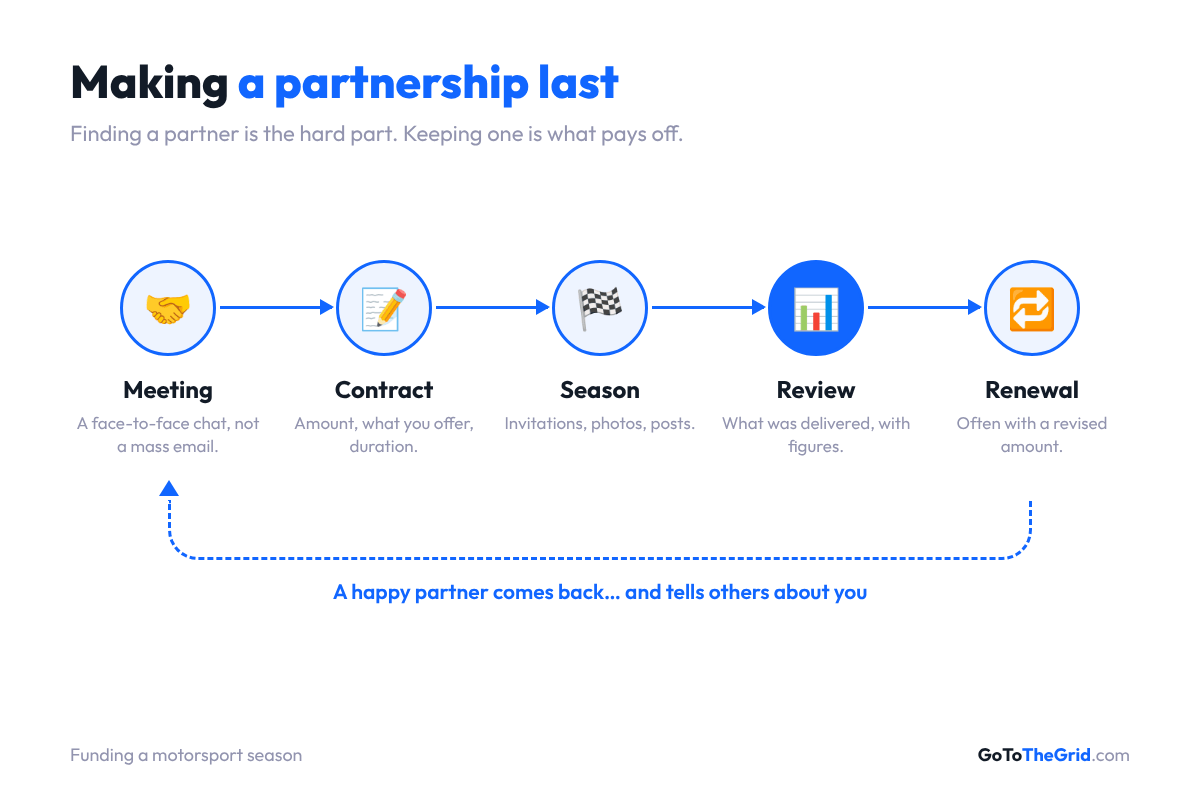
Once you've reached an agreement, put it in writing, even with someone close to you: a simple partnership contract setting out the amount, what you offer, the duration and payment terms. It protects both sides and helps the company justify the expense. At the end of the season, send each partner a review: photos, results, posts and reach figures, events they were invited to. That's what makes them want to carry on the following year, sometimes with a bigger budget.
What the company gains on the tax side (in France)
This is often the argument that reassures a business owner most. In France, there are two distinct regimes:
| Sponsorship (parrainage) | Patronage (mécénat) | |
|---|---|---|
| Principle | An advertising expense, with something in return (visibility, invitations…) | A donation, with no real return |
| Tax benefit | Deductible business expense (art. 39-1-7° of the French tax code) | Tax reduction of 60% of the donation (40% above €2M), capped at €20,000 or 0.5% of turnover excl. VAT, whichever is higher (art. 238 bis) |
| For whom? | Any recipient: association, driver, team… | Public-interest organisations only |
These tax rules (rates, caps, thresholds) change regularly: they are given for information only and should be checked when you sign, ideally with your accountant.
For an amateur driver, it's therefore almost always sponsorship. The expense is deductible if it genuinely serves the company's interest and the amount stays proportionate to what it gets in return. If the payment mainly serves the boss's personal passion, the tax authorities can refuse the deduction. Hence the value of a contract, invoices and proof of the benefits delivered (photos, articles, posts).
⚠️ An association that funds a driver's season generally cannot issue patronage tax receipts: it doesn't meet the public-interest criteria, since it mainly benefits a small circle of people. So don't promise a partner a 60% tax reduction.
How to invoice a partner: the non-profit association (loi 1901)
To deduct a sponsorship expense, a company must be able to justify its business interest, what it received in return and the amount paid. A proper contract and invoice make this much easier. That's why many amateur drivers set up a French "loi 1901" association, by far the most common model. You'll see them all over the paddock, as "racing teams" or "écuries". It isn't the only option (a team can also invoice the partner directly, for example), and setting up an association doesn't exempt you from tax rules.
Why the association is the most common model
It can collect partners' money and issue them an invoice, and it separates the project's accounts from your personal finances. It can also bring together several drivers, a co-driver, volunteers or a small support crew, and run events or an online fundraiser to top up the budget.
Setting up an association in practice
- Write the statutes: name, purpose (for example "practising and promoting motorsport"), registered office, how it runs.
- Bring together at least two people to found it. In practice, a president and a treasurer.
- Register the association online with the préfecture, via service-public.fr. Registration and publication in the Journal officiel are free.
- Open a bank account in the association's name.
- Request a SIRET number from INSEE if needed, especially for activities subject to VAT or business taxes. It's often useful when invoicing companies.
The association's money funds the sporting project: entry fees, rental, parts, tyres, travel… Funding a driver's racing costs and paying them a salary are two very different things. In a small association of amateur drivers, the officers are in practice unpaid volunteers, expense claims must be justified, and the association's money can't be used like personal money. This is known as disinterested management.
VAT and taxes: the point not to overlook
It's often overlooked, but sponsorship is commercial income: the association is selling an advertising service. In principle, it's therefore subject to VAT and business taxes.
However, an association can benefit from a business tax exemption (VAT, corporation tax and CET) if it meets three cumulative conditions:
- disinterested management;
- non-profit activities that clearly remain the majority;
- annual commercial income below a ceiling revised every year, set at €81,051 for 2026.
For an association whose resources come mainly from sponsorship, the "majority non-profit activities" condition can be questionable. The tax authorities look at what the association actually does: one that mainly funds a single driver's season by selling visibility doesn't automatically qualify for the exemption. The safest option is to have your set-up checked by an accountant before signing your first partners. It avoids nasty surprises, for you and for them.
💡 For small contributions from individuals (family, friends, followers), an online fundraiser in the association's name, via a platform such as HelloAsso, is a good solution. Note that these are donations with no tax benefit for the donor.
The mistakes that put partners off
At GoToTheGrid, sponsorship proposals arrive every week. And many make the same mistakes:
- The mass mailing, sometimes without even a hello, with every recipient visible in copy;
- the generic 40-page proposal, clearly churned out or written by AI, with nothing tailored to the company;
- a request out of touch with reality: €30,000, €50,000 or €100,000 asked of an unknown company, with no concrete return. One recent example: €20,000 requested to race in the SWS, so in rental karts, with helmet stickers in exchange…
- waiting passively: wanting to race and expecting sponsors to turn up on their own.
A young driver once replied "can't be bothered, it's too complicated" to advice on putting together a proposal and approaching companies. But finding a budget is the hardest part of motorsport. Nobody funds a project if the driver isn't putting energy into it.
Can you fund your season with prize money?
Depending on the championship, there may be prize money, tyres, free entries or awards. And some promotional series offer very attractive end-of-season rewards. A few examples:
- Clio Trophy France: more than €125,000 in parts vouchers and prize money over the 2026 season, and an official drive in 2027 for the best Junior. More in our article on the Clio Trophy.
- Ligier JS Cup France: the best Junior is given a Ligier JS P4 for the following Ligier European Series season. In that series, the JS2 R champion receives €100,000 to move up to JS P4, and the JS P4 champion €150,000 to step up to the Michelin Le Mans Cup.
- Rallye Jeunes FFSA: a talent search open to French nationals under 24 holding a car driving licence, for a €20 entry fee and with no FFSA licence required. Finalists gain access to development programmes in competition.
In rallying, other rally cups and one-make championships also reward the best young drivers, with a drive or support for the following season.
But don't confuse the value of an award with a paid-for season. Even with a free drive, there are often still entry fees, tyres, fuel, travel, crash damage… And above all, these rewards only go to the best. There's only one winner.
ℹ️ Prize money can really help, but funding an entire season with it alone is almost impossible in amateur motorsport. Better to assume money will go out, not come in.
Can you get paid to race?
It's the dream of many enthusiasts, especially younger ones. It's possible, but extremely rare. First, you need to distinguish three very different situations: being a professional driver, actually paid to race; racing for free, because a team or manufacturer funds your seat; or bringing in enough partners to cover part or all of your season, or even more.
In the vast majority of cases, you first have to pay to race: the time it takes to get known, get results and build a network. And winning in a small, low-budget category is almost never enough to get spotted. Even very quick drivers, with titles in recognised championships, still have to find a budget.
Performance helps, of course. But being fast isn't enough. A slightly slower driver who knows how to find partners, communicate and build a project will often race far more. It isn't necessarily fair, but that's how motorsport works. In F1, the money question is even bigger, as explained in our article on getting into Formula 1.
Motorsport without being rich: the right habits
Racing without being rich is possible. Without money, it isn't. A few habits to make your budget go as far as possible:
- The purchase price isn't your budget. With €15,000 in total, buying a €15,000 car leaves nothing for entry fees, tyres, fuel, travel, servicing and crash damage.
- Prioritise track time. Better 4 or 5 races in a small car than one or two outings a year in a big one.
- Think endurance. Sharing the car brings the cost per hour on track right down. In an 8-hour Fun Cup race, with practice and qualifying, you can approach 15 hours of track time over the weekend, shared between three drivers.
- Rent rather than buy to start with. In rallying, a regional rally in a rented N1 or N2 Série car starts at around €1,000 to €1,500.
- Start as a co-driver. In rallying, the right-hand seat costs far less and is a great way to learn.
- Don't go into the red. Motorsport is a passion: it shouldn't put your finances at risk.
To get started on a smaller budget, several entry points exist:
- slalom in the Loisir class, with your everyday car;
- autocross, which offers great value for thrills if you have some basic mechanical skills;
- karting, as long as you stay reasonable: see the budget for a competition kart;
- on circuits, the Twin'Cup, the smaller TTE classes or the 2CV/C1 Racing Cup;
- in rallying, see how much your first rally costs.
And for circuit racing, our guide to getting started in circuit racing covers every step, from licence to first race.
My take: not rich, but not without effort
Saying you have to be rich to do motorsport is wrong. And it's mostly an easy excuse not to try anything. Money helps enormously, of course: more track time, more testing, better equipment, coaching… But many amateur drivers race every year without coming from a wealthy family.
What they have in common is organisation, a network they look after, partners they treat well, and plenty of motivation. A budget is built bit by bit, often starting small. And once you're on track, you quickly understand why so many people hang on 😉
👉 How do you fund your seasons? Got a question about sponsorship or budgets? Feel free to ask it in the comments of the YouTube video, I'll be happy to answer 😉
[VIDEO] MOTORSPORT without being RICH: is it possible? (Answering your questions) – in French
FAQ: funding a motorsport season
How do you find motorsport sponsors when you're starting out?
Start with your circle: your own business, those of family and friends, then local companies. Offer concrete benefits (invitations, content, presence at an event) rather than just stickers, and personalise every approach.
Do you need to set up an association to find sponsors?
In France, it's the most common model among amateur drivers. A "loi 1901" association can collect partners' money, issue them an invoice and keep the project's accounts separate from your personal finances. Registration is free and done online.
Is sponsoring a driver tax-deductible for a company?
In France, yes, as an advertising expense, if it serves the company's interest with a real return and a proportionate amount. It does not, however, qualify for the 60% patronage tax reduction, which is reserved for public-interest organisations.
Can you fund your season with prize money?
Rarely. Some series offer attractive awards (official drive, parts vouchers, support to move up a category), but they only go to the best and almost never cover all the costs of a season.
Can you do motorsport without being rich?
Yes, but not without money. By choosing an affordable category, prioritising track time, renting at first and finding a few partners, many amateurs race every year on a reasonable budget.


I'm Robin, 36, amateur driver and internet entrepreneur. I founded GoToTheGrid (GTTG) to create an intuitive platform dedicated to motorsport enthusia... See more