

 Login
 Post an ad


Toyota GR KART: the $2,500 kart that wants to open up karting to families
By RobinB on 20 October 2026 Karting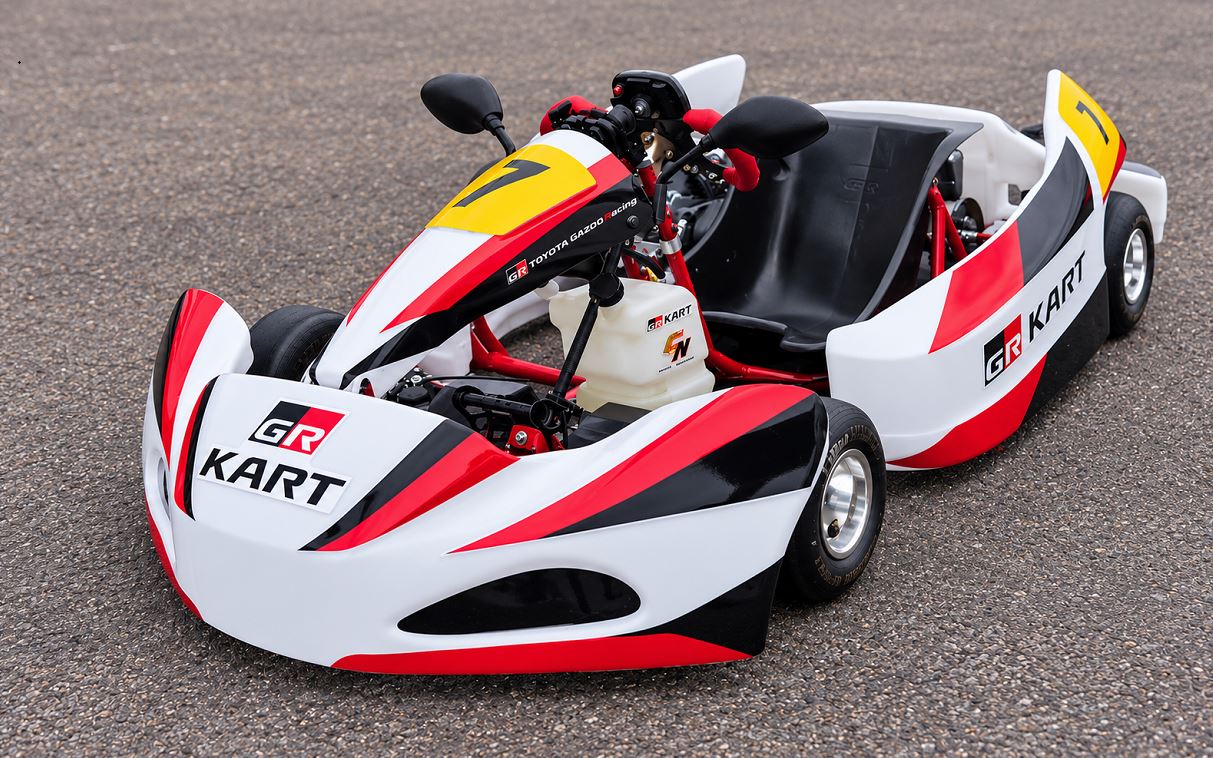
Toyota Gazoo Racing isn't just about WRC, WEC and GR Yaris anymore. Since 10 September 2026, the Japanese manufacturer has also been selling… a kart 😮 Its name: the GR KART.
A real circuit kart, with a four-stroke engine, sold for ¥385,000 in Japan (around $2,500). Roughly four times cheaper than a traditional racing kart. And the whole thing fits in the back of a minivan.
But at this price, Toyota isn't trying to take on Tony Kart, Birel ART or CRG. The GR KART answers a much deeper problem: Japanese karting is losing its drivers. Price, specs, running costs, what drivers think and a possible European launch: here's everything you need to know.
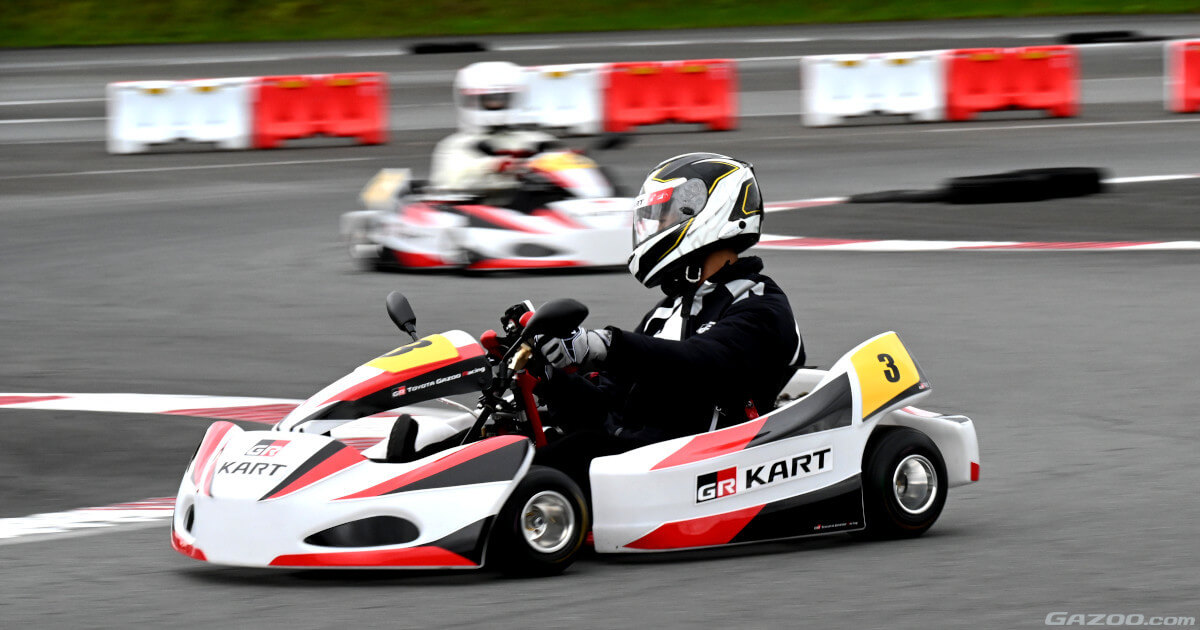
How much does the Toyota GR KART cost?
ℹ️ The GR KART sells for ¥385,000 including tax in Japan (around $2,500), depending on the exchange rate. It has been available since 10 September 2026, in Japan only.
During development, Toyota aimed for around a quarter of the price of a European-made racing kart. In Japan, a complete kart with its engine easily exceeds one million yen (around $6,500).
Of course, comparing this price directly with a Rotax, an X30 or a KZ doesn't make much sense: the GR KART is much less powerful, and its goals are different. But every technical choice was made with one aim: bringing the price down 💸
What about tyres and parts?
A cheap kart is pointless if the consumables cost a fortune. Toyota clearly gets that.
On some racing karts in Japan, a set of tyres costs ¥40,000 to ¥50,000 (around $260 to $325). On the official GR KART store (Rakuten), a front slick costs ¥3,500 (around $23) and a rear ¥4,500 (around $29), so ¥16,000 for a full set (around $105). Toyota also says the tyres are designed to last two to three races.
A set of wets costs ¥22,000 (around $145). As for parts, the drive belt is ¥2,000 (around $13) and the complete clutch ¥25,000 (around $160). Everything can be ordered directly from the official store, part by part, down to the smallest washer, without going through a team or specialist dealer 👍
Toyota also sells driver gear at tight prices: suit at ¥32,000 (around $210), helmet at ¥24,000 (around $155), gloves at ¥8,500 (around $55) and racing boots at ¥17,500 (around $115). That's about ¥82,000 (around $530) for a full kit. To know what you need, see also my complete karting equipment checklist.
GR KART specs: engine, top speed, weight
| Specification | Toyota GR KART |
|---|---|
| Engine | GR200S, single-cylinder four-stroke, 215 cc |
| Power | 5.1 kW (7 hp) |
| Top speed | Around 60 km/h / 37 mph (Fuji kart track) |
| Transmission | Belt drive with automatic tensioner |
| Starting | Electric or pull-start, self-charging lithium battery |
| Fuel | Regular unleaded |
| Brakes | Hydraulic opposed two-piston caliper |
| Weight | 83 kg (with oil, without fuel) |
| Dimensions | 1,820 × 1,160 mm, 1,045 mm wheelbase |
| Driver height | From 1.35 m to 1.85 m (4'5" to 6'1") |
A four-stroke engine with just 7 hp
No 20, 30 or 40 hp two-stroke here. The GR200S is a 215 cc single-cylinder four-stroke producing 7 hp. It runs on regular unleaded, with no fuel mix to prepare. Its diaphragm carburettor prevents fuel level changes in corners, and its built-in lithium battery recharges itself.
The result: around 60 km/h (37 mph) flat out, a long way from the 100+ km/h of a modern racing kart. Toyota fully owns this: the priority is fun, simplicity and cost, not the last tenth. And with little power, you have to work on your lines and corner exits to carry speed. A great way to learn 😉
Slower than a rental kart?
With 7 hp and 60 km/h, the obvious comparison is the rental kart. At leisure tracks, you often drive Sodi karts with 270 or 390 cc Honda four-stroke engines:
| Kart | Power | Weight (without driver) |
|---|---|---|
| Toyota GR KART (215 cc) | 7 hp | 83 kg |
| Honda GX270 rental kart | ≈ 9 hp | ≈ 150 to 165 kg |
| Honda GX390 rental kart | ≈ 13 hp | ≈ 160 to 185 kg |
On paper, the GR KART has less power, but it's half the weight. With a 70 kg driver, it works out at about 22 kg per hp, between a 270 cc rental (about 26 kg/hp) and a 390 cc (about 19 kg/hp). And its 60 km/h top speed is roughly what you reach in a rental kart, as they're often restricted depending on the track.
In other words, in pure performance terms, the GR KART is in the same league as a good rental kart, not a racing kart. The difference is that it's yours, it's lighter and more agile, and it opens the door to real racing, in Japan at least for now.
In Europe and beyond, leisure karters already have their own championship on rental karts: the Sodi World Series (SWS), which lets you race competitively without owning a kart.
Even the chain is gone
The chain drive is replaced by a belt with an automatic tensioner. No more adjusting tension, no more greasing the chain, no more oil spray.
It may surprise anyone coming from traditional karting. But it perfectly suits the target audience: people who want to drive hassle-free.
A deliberately simple chassis
Toyota lists a 31.8 mm main tube in steel, with no mention of chromoly, the more expensive alloy used on virtually every racing chassis. Toyota also draws on its industrial know-how: part of the welding is done by robots, to cut costs and improve consistency. The kart is built in a dedicated workshop in Gamagori, Aichi Prefecture.
Safety was also designed with beginners in mind:
- wrap-around rear bumper: the rear wheels are well protected, to stop one kart riding over another in a contact;
- stopper pins on the rear hubs: even if it's not fully tightened, a hub can't slide off the axle and lose a wheel;
- throttle cable routed so it can't snag: no more stuck throttle, a classic when the cable rubs or kinks;
- seat shaped to keep hands away from the exhaust, to avoid burns when pushing or handling the kart.
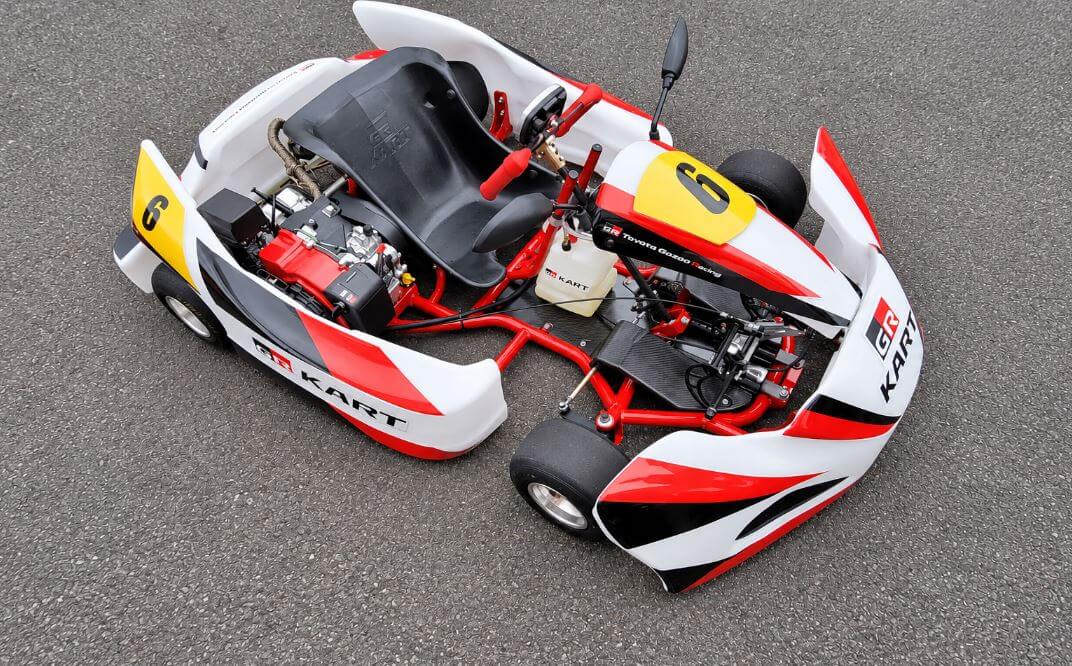
One kart for the whole family
This is probably the smartest idea in the project: Toyota wants a family to be able to buy a single kart for everyone.
The GR KART fits drivers from 1.35 m to 1.85 m (4'5" to 6'1"), thanks to:
- pedals adjustable to 8 positions;
- a height-adjustable steering wheel and telescopic column;
- a seat with two mounting positions.
A weight box can hold up to 15 kg of ballast to even out driver weights in racing. So a child can drive the same kart as their dad or mum 👨👧
For the youngest drivers or complete beginners, Toyota even offers an optional speed limiter (¥22,000, around $145), which caps engine revs. A gentle way to do your first laps, then remove the limiter once you've got the basics 😉
It fits in a minivan
Toyota also tackled an often-overlooked obstacle: how do you get the kart to the track? A traditional kart usually means a trailer or a van.
The GR KART, on the other hand, loads in one piece into a Toyota Noah or Voxy, two family minivans that are very common in Japan (but not sold in Europe or the US), without removing the wheels or sidepods. At home, it stores upright on a dedicated stand to save space.
These accessories aren't free though: the Noah/Voxy carrier costs ¥98,000 (around $635) and the upright storage trolley ¥55,000 (around $355).
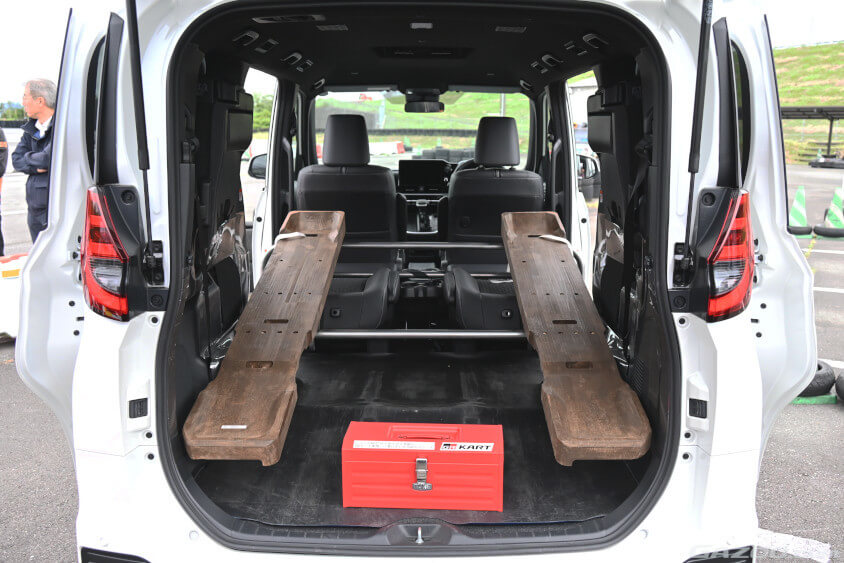
It's not spectacular, but it makes sense: Toyota isn't just working on the kart's price, but on everything that stops a family from getting started.
To learn about the categories and budget for kids' karting, see also my article: what age can you start karting?
Why is Toyota getting into karting?
You often read that Japanese karting has lost 60% of its licence holders. I checked the official JAF statistics, Japan's motorsport federation.
ℹ️ In 1995, the JAF issued 9,703 karting licences. In 2025, only 3,250 were left. That's a 66.5% drop in 30 years, even more than the 60% often quoted 📉
This is the decline Toyota wants to stop. According to the official press release, the idea comes from Akio Toyoda himself: making motorsport as accessible as football or baseball. Tomoya Takahashi, president of Gazoo Racing Company, agrees: in his view, today's racing karts are so expensive that only children from wealthy families can take part.
Toyota doesn't want to compete head-on with traditional racing karts either. The idea is to add a step below, to create new motorsport fans… some of whom will then move up.
Where can you drive and race a GR KART?
The GR KART is sold at 36 Japanese circuits and 7 GR Garages. Owners get a Driver Passport, built into the GR app, which lets them drive at partner circuits without buying each track's own licence.
On the racing side, the GR KART will become the entry class of the SL Kart Meeting from 2027, a very well-developed karting race network in Japan. A specific licence will then be required to race.
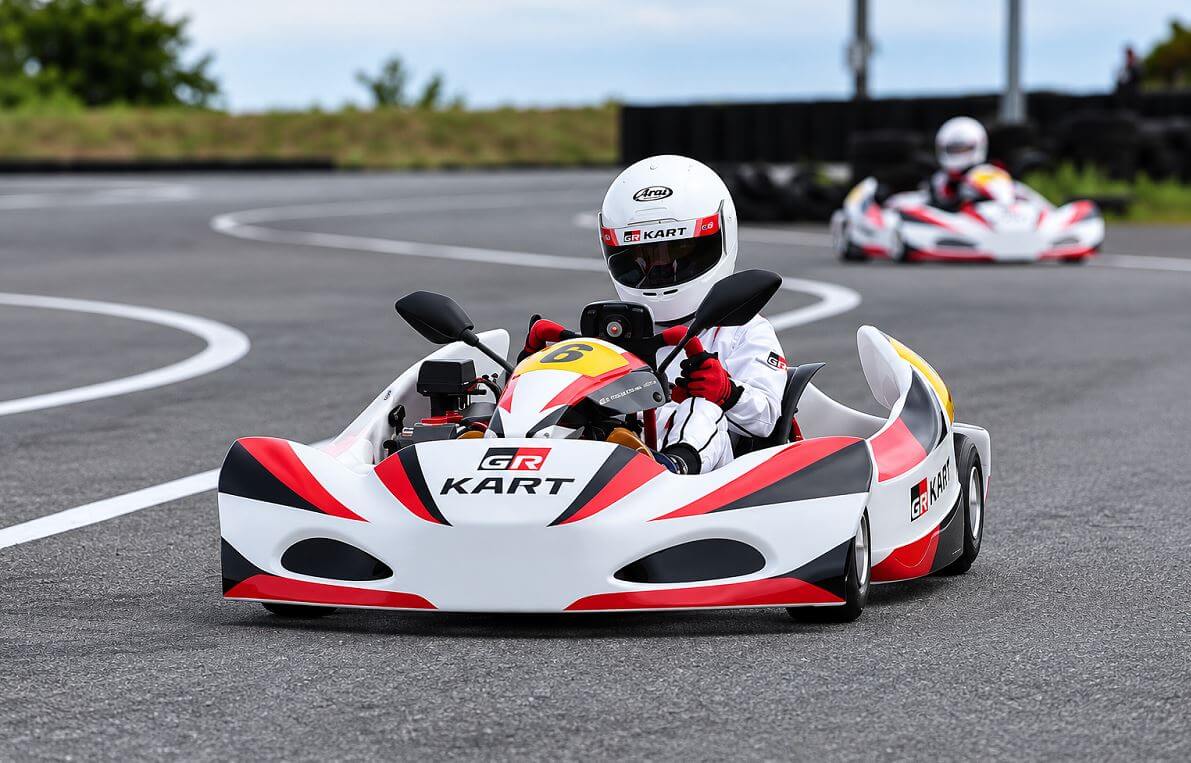
Will the Toyota GR KART come to Europe?
Not for now. The GR KART is only sold in Japan, and no European launch has been announced.
The door isn't closed, though. The Gamagori workshop can build 1,000 to 2,000 karts a year, and Toyota has said it is studying exports, without naming any countries.
The main obstacle is regulatory. The GR KART wasn't designed around the standards of the FIA Karting classes used in Europe. Its 215 cc four-stroke engine, belt drive and chassis don't match the usual homologations. So it couldn't simply turn up and race against Rotax, X30, OK or KZ karts.
ℹ️ If it ever comes to Europe, the most likely scenario would be a Toyota one-make cup, with its own rules, tyres and races. A very accessible first step for Toyota Gazoo Racing Europe… but for now, nothing has been announced.
In Europe, affordable classes to start racing already exist, such as KA100 or the new KFS, two low-budget two-stroke formulas.
In the meantime, to get into karting, see my guide to buying a used go-kart, the karts for sale on GoToTheGrid and my article on the budget for recreational competition karting.
What do drivers and fans think?
To prepare this article, I went through the Japanese and international press, karting forums and social media. Opinions are far from unanimous 👇
A very positive reception
In Japan, social media reactions are almost unanimous: the level of equipment for the price impresses, as does being able to load it into a Noah or Voxy and drive as a family. Abroad, the motoring press welcomes the idea, with just one real frustration: it's only sold in Japan. In the comments, many wish they could order one from their local dealer 😅
Many also find it remarkable that a manufacturer the size of Toyota still invests in products for enthusiasts, at a time when motorsport is sometimes frowned upon, between noise, pollution and its image as a rich person's hobby.
Behind the wheel: between a rental kart and a racing kart
In a test of the prototype, the Japanese karting outlet Paddock Gate describes a lively, agile chassis and a driving position you can adjust in seconds. The engine behaves like a typical 200 cc four-stroke: decent, but without the punch of a two-stroke. A pro driver also noted slightly nervous steering and a rear end that steps out easily at full throttle in the dry, partly due to the narrow track width.
A marketing stunt?
On American karting forums, some karters remain sceptical. For some, it's mostly a low-cost marketing exercise for Toyota, which risks ending up like other one-make programmes before it: a small niche. Others fear a big corporation coming in, shaking up the market… then leaving.
Others see a real upside: a manufacturer like Toyota getting involved could give karting credibility with the general public, and the price could also appeal to rental track operators.
The real cost of karting lies elsewhere
On the forums and social networks I went through to prepare this article, some karters temper the enthusiasm. Slashing the price of the kart doesn't automatically make karting accessible: there are still tyres, fuel, parts, driver gear, travel, race entries, sometimes hotels…
One user even says that most families still couldn't race seriously, even if the kart were free. It's not a statistic, but the reasoning holds up. And that's exactly why Toyota also worked on the price of tyres and parts.
The model to follow: the Briggs & Stratton LO206
Some karters see two scenarios: either the GR KART carves out a real place in low-budget club karting, or it stays a small niche one-make class.
The ideal scenario already exists: the Briggs & Stratton LO206. This 206 cc four-stroke, around 9 hp, is factory-sealed: it can't be tuned, so everyone races on equal terms. It costs under $800, needs little maintenance, and the same engine covers Cadet, Junior and Senior classes by adjusting weight and carburettor. The result: it has become one of the most popular classes in the US and Canada, with thousands of drivers.
The GR KART shares the same philosophy: four-stroke, cheap, simple, identical for everyone. With Toyota's muscle and network, it could play a similar role in Japan, or even across Asia. But building an affordable machine is relatively easy for a group like Toyota. Building enough circuits, races and drivers so that every owner finds rivals is much harder. That's where the GR KART's success will be decided.
My take: an idea that goes against the grain
7 hp, 83 kg, 60 km/h and around $2,500. On paper, it almost seems too simple.
The GR KART won't turn karting into a cheap hobby. But Toyota is trying something rare in modern motorsport: cutting costs rather than adding ever more performance and technology. And not just on the kart: on tyres, parts, transport and storage too.
Let's be honest: as it stands, the GR KART won't shake up competitive karting. With 7 hp and 60 km/h, it's first and foremost a machine for kids, families and beginners, not a weapon for chasing titles. But that's exactly its job, and it's great to see a manufacturer like Toyota getting involved.
Seen this way, the GR KART is almost more a tool for building a community around Toyota Gazoo Racing than an attack on European manufacturers. In a country that has lost two thirds of its karting licence holders in thirty years, this kind of simplicity may be exactly what was needed.
The question is whether Toyota will dare to export it. Personally, I don't see myself racing a GR KART. But a low-cost entry class to introduce young people to karting in Europe? Why not 😉
👉 What about you: would a $2,500, 7 hp kart tempt you to start out or drive with your family? Or without a real two-stroke, is it not really karting ❓
FAQ: Toyota GR KART
How much does the Toyota GR KART cost?
The GR KART sells for ¥385,000 including tax in Japan, around $2,500 depending on the exchange rate.
Can you buy the GR KART in Europe or the US?
No, not for now. It's only sold in Japan, at 36 circuits and 7 GR Garages. Toyota is studying exports, but no launch outside Japan has been announced.
What is the GR KART's top speed?
Around 60 km/h (37 mph) according to Toyota on the Fuji Speedway kart track, with a 7 hp four-stroke engine.
How much does the GR KART weigh?
83 kg, including engine oil but without fuel.
Can an adult drive the GR KART?
Yes. The kart fits drivers from 1.35 m to 1.85 m (4'5" to 6'1") thanks to its adjustable pedals, steering wheel and seat. The whole family can share the same kart.
Can you race the GR KART?
Yes, in Japan. It will become the entry class of the SL Kart Meeting from 2027, with a specific licence. In Europe, it doesn't match the FIA Karting homologated classes.


I'm Robin, 36, amateur driver and internet entrepreneur. I founded GoToTheGrid (GTTG) to create an intuitive platform dedicated to motorsport enthusia... See more