

 Login
Login
 Post an ad


Briggs LO206: How a 4-Stroke Engine Conquered the Karting World
By RobinB on 11 November 2025 Karting
The Briggs & Stratton LO206 is a 204 cc 4-stroke karting engine that conquered North America before gradually spreading to other regions of the world, thanks to its simplicity, reliability, and low cost, both to buy and to run 👌
ℹ️ This category, often simply called “206” or “Lo206”, is a star spec series in the United States: a factory-sealed ~9 hp engine (so impossible to tune), mounted on a standard chassis, for closely-matched, equal-equipment racing.
The success is such that some events gather up to 500 drivers in LO206, notably at major meetings like the Cup Karts North America 🤗
ℹ️ Do you prefer watching a video? This article is also available in video format on YouTube, click here! 🎥
Briggs & Stratton: a century of engineering… and racing!
Behind this engine is a historic player in American engineering. Founded in 1919 in Milwaukee, Briggs & Stratton is one of the world’s largest manufacturers of small gasoline engines for industry, gardening, and leisure. Racing has always been part of its DNA: as early as the 1930s, its blocks powered 1/4 midgets, and later junior dragsters, karts, and even student prototypes in engineering competitions. In 1991, the brand formalized its Briggs Racing division to offer engines dedicated to amateur competition. The LO206, launched in 2009, is the culmination of this approach: a sealed, reliable, and economical unit, designed for hassle-free racing 💪
Let’s look in detail at the characteristics of this engine and why it inspires so much enthusiasm—along with a few criticisms—in the karting world 🤔
Technical sheet: the Briggs LO206 in detail

🛠️ The Briggs & Stratton LO206 engine (above) is a 204 cc single-cylinder 4-stroke delivering around 9 hp. Designed specifically for racing, it is sealed and governed by a strict rule set to ensure perfect parity between all units.
- Engine type: Single-cylinder 4-stroke OHV (overhead valves), air-cooled, designed specifically for competition. Runs on unleaded gasoline. Pull-start with integrated recoil starter (lawnmower-style).
- Displacement: 204 cc (bore 68.3 mm, stroke 68.3 mm).
- Power & torque: 8.8 hp (≈ 9 hp) at 5500 rpm, 13.5 Nm (≈ 10 lb-ft) of torque 🔥
- Compression: 8.5:1.
- Ignition: Digital electronic with built-in limiter at 6100 rpm.
- Valve train: Camshaft with 0.255” (6.48 mm) lift, nitrided steel valves, high-strength springs, reinforced lifters.
- Carburetor: Briggs 22 mm round-slide, stock jets fixed per regulations (IKF/WKA/Briggs Rule Set).
- Lubrication: Wet sump; oil change every 1 to 2 hours of running per manufacturer recommendations.
- Transmission: Single-speed centrifugal clutch (classic on 4T karts), chain drive.
- Construction: Cast-iron lined block, nitrided steel crankshaft, reinforced T-7 aluminum connecting rod, cast aluminum flywheel, aluminum head with high-velocity port.
- Max rpm: 6100 rpm (integrated rev limiter).
- Engine weight: approx. 17 kg (complete with clutch and exhaust).
- On-track performance: Top speed up to 90 km/h depending on gearing and circuit.
- Maintenance: Very low. No gearbox or liquid cooling, few adjustments. Periodic cleaning of air filter, carburetor, and clutch recommended. No rebore or piston change required in the short term: a well-maintained LO206 can last several full seasons without performance loss.
ℹ️ Briggs & Stratton developed this engine specifically for club-level competition.
Each unit is hand-assembled at the Milwaukee factory and sealed before delivery. The carburetor (22 mm round-slide) and ignition timing are stock and fixed by the rulebook. The aim is to prevent any tuning: “If the rulebook doesn’t say you can do it… then you can’t do it,” sums up Briggs’ philosophy. This technical stability ensures that all drivers enjoy near-identical performance, putting the emphasis on driving rather than engineering 😎

An engine that revived club karting in the United States and Canada
Introduced in 2009, the Briggs LO206 truly revolutionized leisure-competition karting in the United States and Canada. Faced with rising costs in traditional 2-stroke categories, this engine gave club karting a real boost by offering a simple, inexpensive, and fun way to go racing. The recipe: a modest initial outlay and minimal running costs 🤑
Also read: “What is the budget required to drive a competitive kart ?”
Compared with other classes, the 206 formula is considered very affordable, as evidenced by its popularity in virtually every local club across North America.
ℹ️ This is a category where you can build a competitive kart for a fraction of today’s standards: for example, a used chassis for $1,000 is enough—just bolt on a Briggs 206 and you’re ready to race. Even with a more recent chassis, you can find competitive used rolling chassis for $2,500–$3,000, and a brand-new complete engine costs around $750–$800 only (about €700–€750) 🥳
Most importantly, no more rebuilds every 10 hours: a well-maintained 206 will hold its performance for several seasons without a rebore or piston change, saving thousands of euros in overhauls compared with highly-strung 2-strokes 👨🔧

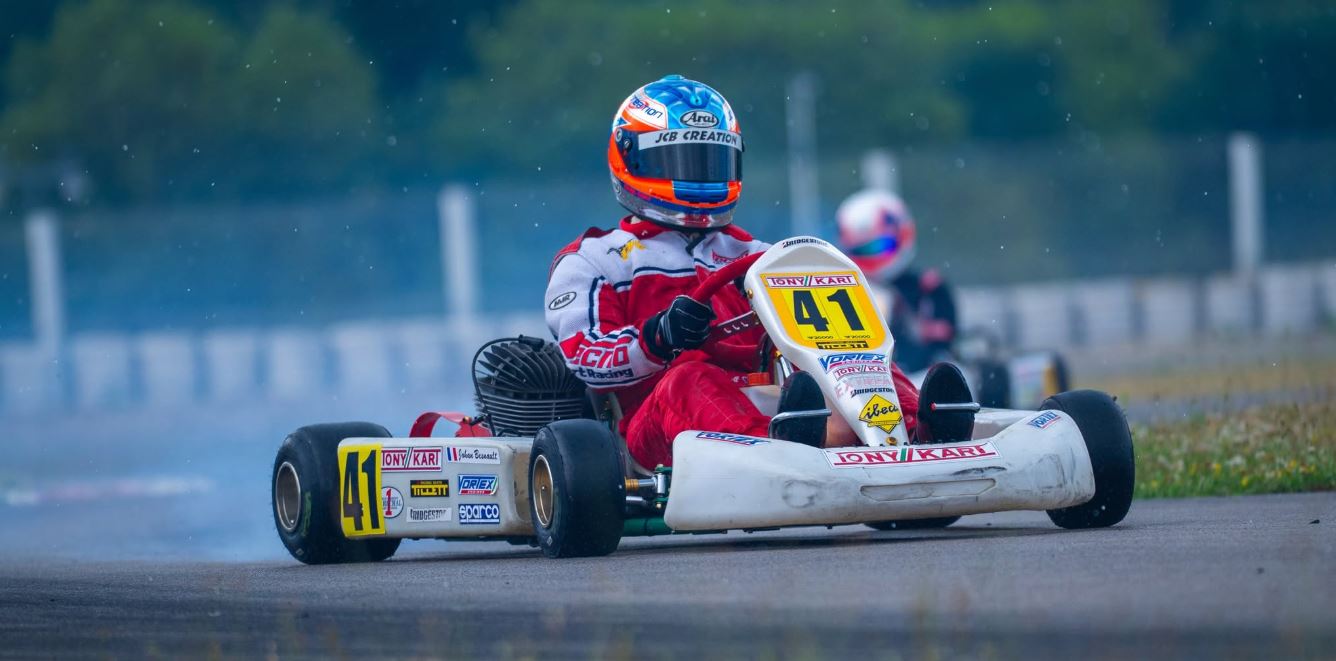
On track, the LO206 category offers authentic driving fun. Admittedly, with ~9 horsepower, you’re far from the brutal acceleration of a Rotax Max or a KZ. But the low power makes driving highly educational: you must carry corner speed, perfect your lines, and work on strategy (drafting, exits) to overtake—fundamentals sometimes forgotten when driving a more powerful kart 🙂
ℹ️ Want to see what it looks like on video? Click here to watch an onboard LO206 race! 🎥
The 206 forces the driver to focus on the basics to be competitive. Every engine is the same, and the modest power demands a smooth, consistent, and precise driving style. Mistakes can’t be masked by extra horsepower. In short, it’s a genuine driving school: many seasoned karters train in LO206 to refine their technique, and young drivers develop solid foundations here before moving up 📈
Fun is also part of the package. LO206 races, often with full grids, are known for wheel-to-wheel battles from start to finish. Technical equality keeps everyone in the same pack, and it’s up to the driver to make the difference 💪
🏆 Note: Some LO206 events in the USA field more than 100 karts in a single class—unheard of in modern karting! 😮
Flagship national events like the Cup Karts North America Grand Nationals now draw impressive grids, with more than 500 drivers across all Briggs LO206 categories. You’ll find all the official classes of the American championship: Kid Kart (5–8), Cadet (8–10), Sportsman (10–13), Junior (12–15), Senior Light, Senior Medium, Senior Heavy (15+), as well as Masters (35+) and Legends (50+). At the 2025 edition, some classes had over 100 entries—a rare spectacle in modern karting that perfectly illustrates the scale of the LO206 phenomenon across the Atlantic 🌎

Lastly, the community spirit shouldn’t be overlooked. The “206” movement has grown into a large, helpful community of enthusiasts. There are countless forums, Facebook groups, and YouTube tutorials dedicated to the LO206, where beginners can easily ask for advice and get help. Briggs & Stratton itself publishes guides (assembly, maintenance, setup) and ensures costs remain controlled for everyone. As a Briggs Racing manager puts it, “At the end of the day, we have to make this sport more accessible… We have to control costs and reduce complexity, because we live in a world where people lack time and mechanical skills. And above all, people need to have fun, because that’s what it’s all about!”
👉 The message is clear: bring karting back to everyone, not just a financial elite 👍
[VIDEO] An LO206 race in onboard footage!
Australia, New Zealand: LO206 success reaches the other side of the world
LO206’s success isn’t confined to the Americas. In Australia and New Zealand, the formula has also developed over several years thanks to players like Aussiespeed, the official supplier of sealed 206 engines and parts. These countries adopted the concept for their local 4-stroke championships (notably the 4SKANSW network in New South Wales), where the Briggs engine progressively replaced the old Subaru KX21 blocks. Again, the success rests on the same recipe: sealed engine, controlled costs, and driving enjoyment first 👌

And in Europe? 4-stroke karting is still finding its place
In Europe, and particularly in France, many consider karting has become an elitist sport, notably since the professionalization driven by the FIA/CIK and national federations. Some veterans nostalgically recall the 1970s–80s, when true promo categories existed (Moteur National, 100cc “Bleue”, Formule France, etc.), allowing modest-means drivers to race on weekends without breaking the bank 💸
Today, the majority of official championships feature very high-performance 2-stroke engines (Mini Rok, OK-Junior, OK, KZ, Rotax, X30, etc.) with sometimes exorbitant associated costs. For example, even at regional level, a season in Mini 60 for a child can easily exceed €8,000–€10,000 all-in (equipment, tires, entries, engine rebuilds, travel), according to parents’ accounts. For international junior/senior categories, budgets are much higher still. This level of spending can discourage many enthusiasts and cements the idea that competition karting has become a “rich man’s sport,” where talent only shines if the wallet follows 😕
Faced with this, the Briggs LO206 concept brings a breath of fresh air, and many are asking: what if we returned to simple, economical formulas to broaden the licensed base? In North America, that bet has clearly paid off.
Alongside the Briggs LO206, there’s also the rise of the T4 Series, a “turn-key” 4-stroke formula launched by Irish manufacturer Tillotson. Built on the same principles of accessibility and mechanical equality, it’s now expanding in over thirty countries worldwide. Each driver runs identical chassis and engine, limiting performance gaps and favoring pure driving. The series includes multiple classes (Junior and Senior) and culminates each year in the T4 Nations Cup, a true world final that brought together more than 200 drivers from 30 nations at its 2024 edition. This success shows the growing interest in affordable 4-stroke championships which—like the Briggs LO206—bring back karting that is simple, fair, and accessible to all.

In England as well, promotion categories remain (e.g., the TKM 4-stroke 200 cc or air-cooled 2-strokes like the TKM BT82).
In France, there’s a comparable initiative outside the FFSA: the UFOLEP, a multi-sport federation, has offered low-cost 4-stroke categories for several years with prepared Subaru industrial engines. The program is managed by Of Course SARL, based in Biganos (Gironde), specializing in the sale and rental of competition karts, as well as the distribution of spare parts and driver equipment.
Also read: “Sodi World Series (SWS): The global competition dedicated to leisure karting”
In UFOLEP Nouvelle-Aquitaine, you’ll find a Subaru 211 cc (~9 hp) for ages 9–13 and a Subaru 402 cc (~14 hp) for adults, mounted on competition chassis. The package remains very affordable: around €4,500 to €5,000 for a brand-new race-ready kart, and an annual license at around €80 only 👏
ℹ️ The concept appeals for its simplicity and reduced costs, but its success remains regional in scope; most French karters continue to favor higher-performance 2-stroke categories.
CRG FS4: when Italy takes inspiration from the American model
Among manufacturers, the Briggs approach has also drawn interest. Inspired by the success of these engines in North America, Italian manufacturer CRG launched in 2017 a Briggs & Stratton 206 program in direct partnership with Briggs & Stratton. This program offered a complete package—CRG FS4 chassis specifically designed for 4-stroke, sealed Briggs LO206 engine (i.e., no modifications allowed), and Vega tires—all for an attractive price of around €2,900 before tax for a ready-to-run kart 😋

CRG’s stated goal is unambiguous: bridge the gap between rental karts and traditional competition karts—an ever-widening divide due to soaring costs and modern karting complexity—by giving amateurs an affordable springboard beyond simple leisure they couldn’t previously access in traditional categories. The concept also banks on particularly low operating costs: a dedicated tire set costs under €100 and the sealed engine requires only minimal maintenance 🛠️
The Briggs Kart Championship, set up by CRG in partnership with Briggs & Stratton, began in Italy in 2018 with more than 40 local events in its first season. Initially limited to the Senior category (16+), the formula quickly expanded with Junior (11–16), Mini (8–12), and Master (35+) classes. Each category has its own minimum weight: 105 kg for Mini, 130 kg for Junior, 145 kg for Senior, and 155 kg for Master ⚖️

This variety has opened competition to a broad audience, from young beginners to experienced drivers. Briggs by CRG races in Italy bring together participants from all backgrounds—from amateurs discovering racing to former champions wanting to drive without overspending—and the concept is beginning to attract other European countries 🌍
ℹ️ Nevertheless, the CRG initiative also revealed a few pitfalls. With the best intentions (providing an ultra-modern “turn-key” kit), the entry ticket remained close to €3,000—modest for a new kart, certainly, but much pricier than the North American philosophy where you can start from a cheap old chassis.
Some observers criticized this approach: “The Briggs program is a huge success in America because you can grab a used chassis for $1,000, bolt on a Briggs, and be competitive. Why force people to buy a dedicated new chassis?” wondered one commenter at the announcement 🤔
Indeed, one of LO206’s strengths is its wide compatibility: you can mount it on just about any (homologated) competition kart chassis, American or European, recent or older. Many US drivers thus repurpose a few-year-old Rotax or 125 shifter chassis to run in the 206 class, maximizing financial accessibility. By locking the formula to a single new chassis, you risk needlessly driving up the bill and “killing the concept before it starts”—especially since Europe’s used-chassis pool is huge if one wished to leverage it 😲
Criticisms… but very real driving pleasure
The Briggs LO206 isn’t free of criticism, especially from purists. The most common concerns its low power: “9 horsepower is just a souped-up rental kart, not a real race kart,” some say. It’s true that, in absolute terms, an adult on a 206 will lap far slower than on a 2-stroke competition engine, which can frustrate those seeking pure performance or running open track with more powerful karts. Some drivers would like a slightly punchier version (there is, in fact, a slightly more powerful Briggs World Formula, and “206 modified” builds—but that strays from the original spirit). Others compare 4-strokes to “lawnmower” or “cement mixer” engines, pointing out the lack of glamour or the sound compared to a 2-stroke singing at 16,000 rpm 🔥

However, LO206 advocates answer that performance isn’t everything. The main goal is to deliver driving fun at a reasonable cost. And on that point, a well-driven 206 is anything but boring: you’ll reach nearly 90 km/h at the end of the straight, brake late, and overtake in the draft… in short, the sensations of speed and competition are very much there 😊
Unlike a leisure rental kart (heavy and with a basic chassis), a true race chassis fitted with a 4-stroke is much more agile and effective. With racing slicks, cornering grip is high, and you can attack hard through turns—hence lap-time gaps that are much closer than you might think compared with more powerful classes.
ℹ️ Above all, the LO206 gives you the chance to race more. For a seasonal budget of €2,000 (or less), you can multiply races and seat time, whereas other, costlier categories might have ended the adventure for lack of funding.
This increased accessibility allows people who might have given up karting (or never started) to practice regularly and progress. That’s what karting was born for: affordable racing for fun, not necessarily to produce world champions. And indeed, many gentlemen drivers whose age or budget isn’t compatible with chasing KZ lap records find in the Briggs a way to keep enjoying competition, in a friendly, educational spirit 😎
LO206: back to the essence of karting
In conclusion, the LO206 may well represent the future of a more democratic karting.
Without claiming to replace the top categories, it offers an entry (or re-entry) level to competition that Europe has sorely lacked in recent years, despite categories like KFS or KA100.
Also read: “The KA100: the best way to get started in karting?”
The question is whether European karting bodies and stakeholders will embrace this model (or its variants) to rebuild the sport’s grassroots. In the United States and Canada, the bet has paid off: the Briggs formula has revived local club grids and nurtured an entire new generation of drivers. In France, initiatives like UFOLEP Subaru are heading in the right direction but struggle to gain visibility against the 2-stroke culture. Still, the global enthusiasm for LO206 proves there’s a real audience for a “fun and affordable” karting category. After all, karting for everyone, in all simplicity—isn’t that a return to the sport’s original spirit? The smiles of hundreds of drivers on an LO206 grid suggest yes—and that may be the most important thing 😉
[VIDEO] What if 4-stroke karting was THE SOLUTION we refuse to see?


I'm Robin, 36, amateur driver and internet entrepreneur. I founded GoToTheGrid (GTTG) to create an intuitive platform dedicated to motorsport enthusia... See more